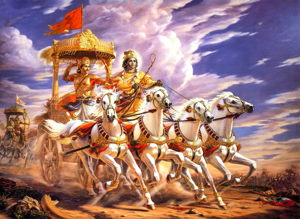
The Bhagavad Gita in the Digital Age: Ancient Wisdom for Modern Tech Life
In an era of endless notifications, AI disruptions, and digital burnout, a 5,000-year-old conversation on a battlefield holds surprisingly relevant answers. The Bhagavad Gita, often seen as a spiritual text, is actually a profound manual for navigating life's complexities—including our hyperconnected, technology-driven world.
The Crisis of Choice Paralysis
Arjuna stood frozen on the battlefield, overwhelmed by infinite possibilities and their consequences. Sound familiar? Today, we face our own version: analysis paralysis in career choices, decision fatigue from endless options, and the anxiety of FOMO scrolling through social media.
श्रेयान्स्वधर्मो विगुणः परधर्मात्स्वनुष्ठितात् ।
स्वधर्मे निधनं श्रेयः परधर्मो भयावहः ॥
"It is better to perform one's own duties imperfectly than to master the duties of another. Even death in one's own dharma is better; another's dharma brings danger." (3.35)
In today's context: Stop comparing your career path to someone else's LinkedIn highlight reel. That influencer's lifestyle, your colleague's promotion, your friend's startup success—they're walking their path. Your authentic journey, even with its stumbles, is more valuable than a perfect imitation of someone else's life.
Karma Yoga: The Antidote to Hustle Culture Burnout
We live in an age obsessed with outcomes: engagement metrics, quarterly targets, viral posts, productivity hacks. The Gita presents a radical alternative—Karma Yoga.
कर्मण्येवाधिकारस्ते मा फलेषु कदाचन ।
मा कर्मफलहेतुर्भूर्मा ते सङ्गोऽस्त्वकर्मणि ॥
"You have a right to perform your prescribed duties, but you are not entitled to the fruits of your actions. Never consider yourself to be the cause of the results, and never be attached to inaction." (2.47)
This isn't about not caring—it's about sustainable excellence. Code your project with full dedication, but don't let your self-worth depend on whether it gets upvoted on Reddit. Create content with sincerity, but don't spiral when the algorithm doesn't favor you. Focus on the craft, not the clout.
Tech giants are learning this the hard way: companies that chase only metrics often lose their soul. Those that focus on genuine value creation (the karma) often find success (the fruit) follows naturally.
Steadiness of Mind: Digital Detox, Ancient Style
युक्ताहारविहारस्य युक्तचेष्टस्य कर्मसु ।
युक्तस्वप्नावबोधस्य योगो भवति दुःखहा ॥
"Those who are moderate in eating, sleeping, working, and recreation can mitigate all sorrows by practicing yoga." (6.17)
Krishna's message: balance. Modern translation? Your smartphone shouldn't be the first thing you touch in the morning and the last at night. That 3 AM coding session might seem productive, but your brain needs rest to function optimally.
The Gita advocates for "yukta"—appropriateness and moderation. Apply this to:
- Screen time: Use technology purposefully, not compulsively
- Information consumption: Curate your feeds; not every trending topic deserves your mental energy
- Work-life integration: Your worth isn't your output; you're not a machine learning model
AI and Consciousness: The Ultimate Question
As we develop artificial intelligence, we're grappling with questions about consciousness, self, and identity. The Gita addressed this millennia ago:
न जायते म्रियते वा कदाचिन्नायं भूत्वा भविता वा न भूयः ।
अजो नित्यः शाश्वतोऽयं पुराणो न हन्यते हन्यमाने शरीरे ॥
"The soul is neither born, nor does it ever die; nor having once existed, does it ever cease to be. The soul is without birth, eternal, immortal, and ageless. It is not destroyed when the body is destroyed." (2.20)
While we may create intelligent systems, the Gita prompts us to ask: What is consciousness beyond computation? Can algorithms ever replicate the awareness that observes thoughts rather than just generating them?
In our quest to create artificial general intelligence, we're forced to confront what makes human consciousness unique—a question Krishna answered by distinguishing the eternal observer (Atman) from the changing mind-body complex.
Detachment in the Age of Addiction
Social media platforms are engineered for attachment—to likes, to validation, to constant stimulation. The Gita's concept of detachment isn't about becoming cold or indifferent; it's about freedom.
योगस्थः कुरु कर्माणि सङ्गं त्यक्त्वा धनञ्जय ।
सिद्ध्यसिद्ध्योः समो भूत्वा समत्वं योग उच्यते ॥
"Perform your duty equipoised, abandoning all attachment to success or failure. Such equanimity is called Yoga." (2.48)
Ship your product. Post your creation. Launch your idea. But don't let your peace depend on the market's response. This equanimity isn't resignation—it's resilience. The most innovative tech leaders often speak of this: loving the problem more than the solution, the process more than the applause.
The Final Lesson: Be the Observer
In a world where we're constantly distracted, fragmented across apps and identities, the Gita offers perhaps its most radical teaching: You are not your thoughts, your job title, your social media persona, or even your achievements.
इन्द्रियाणि पराण्याहुरिन्द्रियेभ्यः परं मनः ।
मनसस्तु परा बुद्धिर्यो बुद्धेः परतस्तु सः ॥
"The senses are superior to the body, the mind is superior to the senses, the intellect is superior to the mind, and superior even to the intellect is the soul." (3.42)
Every time you doom-scroll, you're identifying with the mind's restlessness. Every time you pause and observe that urge without acting on it, you're accessing that higher awareness Krishna speaks of. That space between stimulus (notification) and response (grabbing your phone) is where freedom lives.
Conclusion: Your Battlefield Awaits
Arjuna's battlefield was Kurukshetra. Yours might be a startup garage, a corporate cubicle, a creative studio, or simply the relationship with your own mind in this overwhelming digital age. The weapons have changed from bows to browsers, but the fundamental challenges remain: How do we act without anxiety? How do we engage without attachment? How do we live purposefully in a world designed to distract us?
The Bhagavad Gita doesn't promise easy answers or quick hacks. Instead, it offers something more valuable: a framework for living with clarity, purpose, and peace—no matter how much the external world changes.
As Krishna told Arjuna: "Now stand up and fight."
In today's language: Log off when you need to. But when you're in the arena—create, build, contribute—do it with full presence and zero attachment to the applause.
That's the real revolution.